Feb 10, 2026
User Story: How Omniscient Powers Real-Time Corporate Reputation Management with Linkup
By integrating Linkup’s Deep API and Fetch endpoints, Omniscient has achieved a 3x reduction in hallucinated signals and cut data retrieval latency by 50%.

The Linkup Team
Omniscient is an intelligence-based decision making platform that notably provides AI driven workflows in a high-stakes corner of the market: corporate reputation management. Their system uses autonomous "agentic workflows" to scan the web, identify potential threats to a brand, and verify the legitimacy of claims in real time.
For Omniscient, the core challenge isn't just finding information – it's ensuring their AI agents can "read" and reason through that information without being distracted by the noise of the modern web.
The Friction: Keywords, Scraping, and "Dirty" Data
When Omniscient first launched, they relied on traditional web search methods: targeting keywords and manually scraping the resulting URLs. While this works for human researchers, it created a massive bottleneck for conversational AI.
Format Mismatch: Traditional search results are built for browsers, not agents. Forcing an AI to process raw HTML, navigation bars, and ads led to high latency and "low-signal" inputs.
The Hallucination Baseline: When agents are fed cluttered or incomplete data from slow scraping processes, they are significantly more likely to fill in the gaps with hallucinations – a dangerous outcome when monitoring a client's reputation.
Workflow Stagnation: The "old-fashioned" way of searching wasn't optimized for complex reasoning tasks where agents need to verify hypotheses across multiple sources simultaneously.
"It was not adapted for conversational agents, let alone our agentic workflows which are the backbone of our application. We needed a new way to access the web." – The Omniscient Team
The Solution: A Search Engine Built for Agents
Omniscient moved away from manual scraping by adopting Linkup as their "agent-friendly" search layer. Instead of managing the infrastructure of a web crawler, they now plug directly into Linkup's specialized endpoints:
1. Leveraging Deep mode for Reasoning
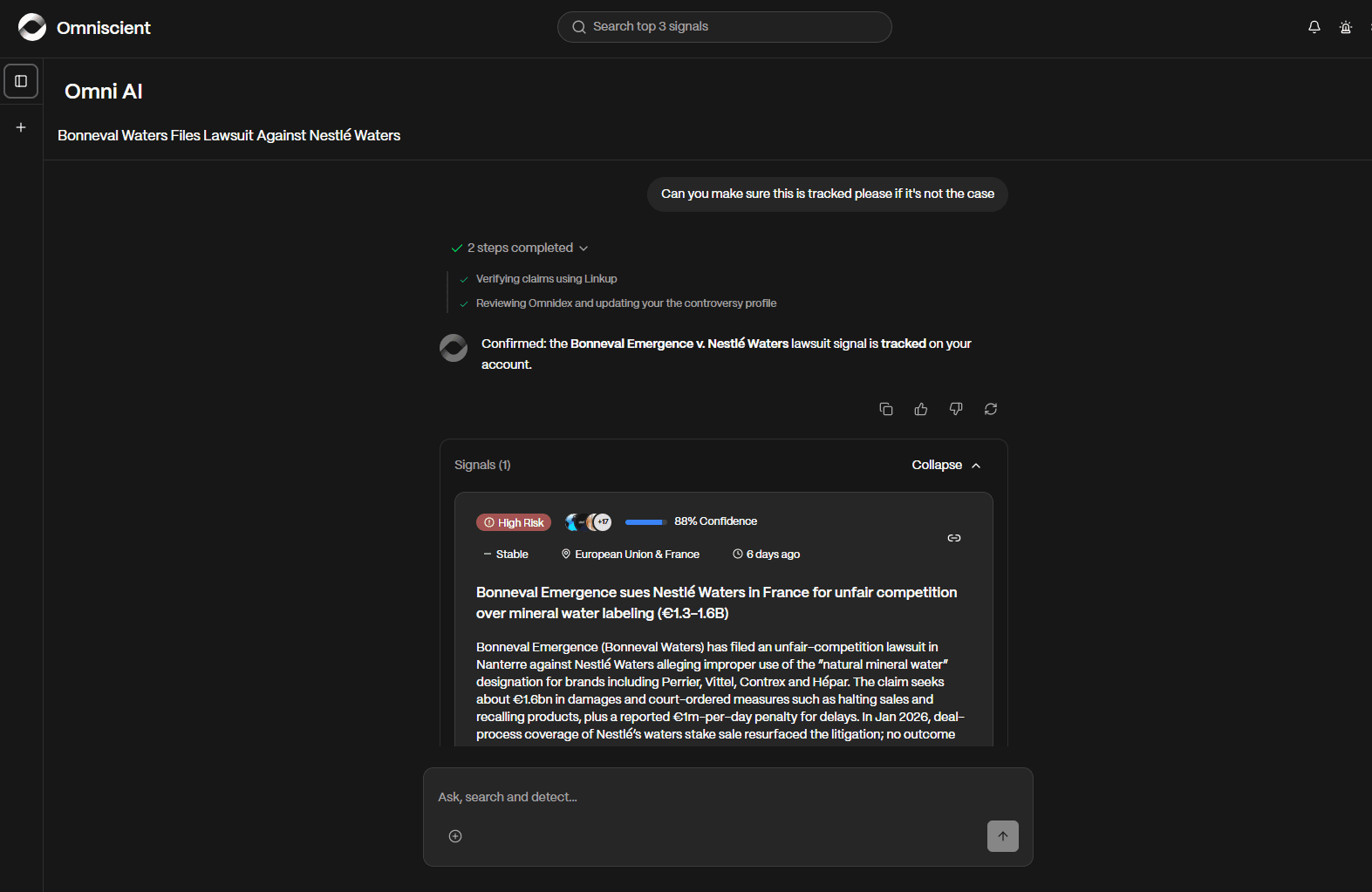
Omniscient uses the Deep mode for both conversational and complex reasoning tasks. Rather than returning a list of links, the API does the sourcing and provides the agents with a direct, grounded answer, complete with citations. This allows the agents to verify if a claim about a client’s reputation is real or fabricated without leaving the workflow.
2. The Fetch Endpoint for "Noise-Free" Content
When an agent needs to perform a deeper investigation into a specific source, Omniscient uses the /fetch endpoint. This converts pages into clean, LLM-friendly Markdown. By stripping away ads and "fat," the agents only see the core text, which significantly improves the quality of their analysis.
3. Token Efficiency
A major win for the Omniscient team was cost-optimization. Because Linkup provides "ready-to-consume" answers and clean Markdown, the agents spend fewer tokens processing irrelevant data. This efficiency effectively offsets the cost of moving from standard search to Linkup’s Deep infrastructure.
Implementation: Agent-Level Verification in Practice
Omniscient embeds Linkup directly into its agentic workflows via explicit tool-use instructions at the prompt level. One common use case is claim credibility verification.
When a potential issue is detected, agents follow a structured verification sequence:
Trigger: The claim is flagged with a low credibility score based on deterministic heuristics. The agent is instructed to verify the claim using its available tools.
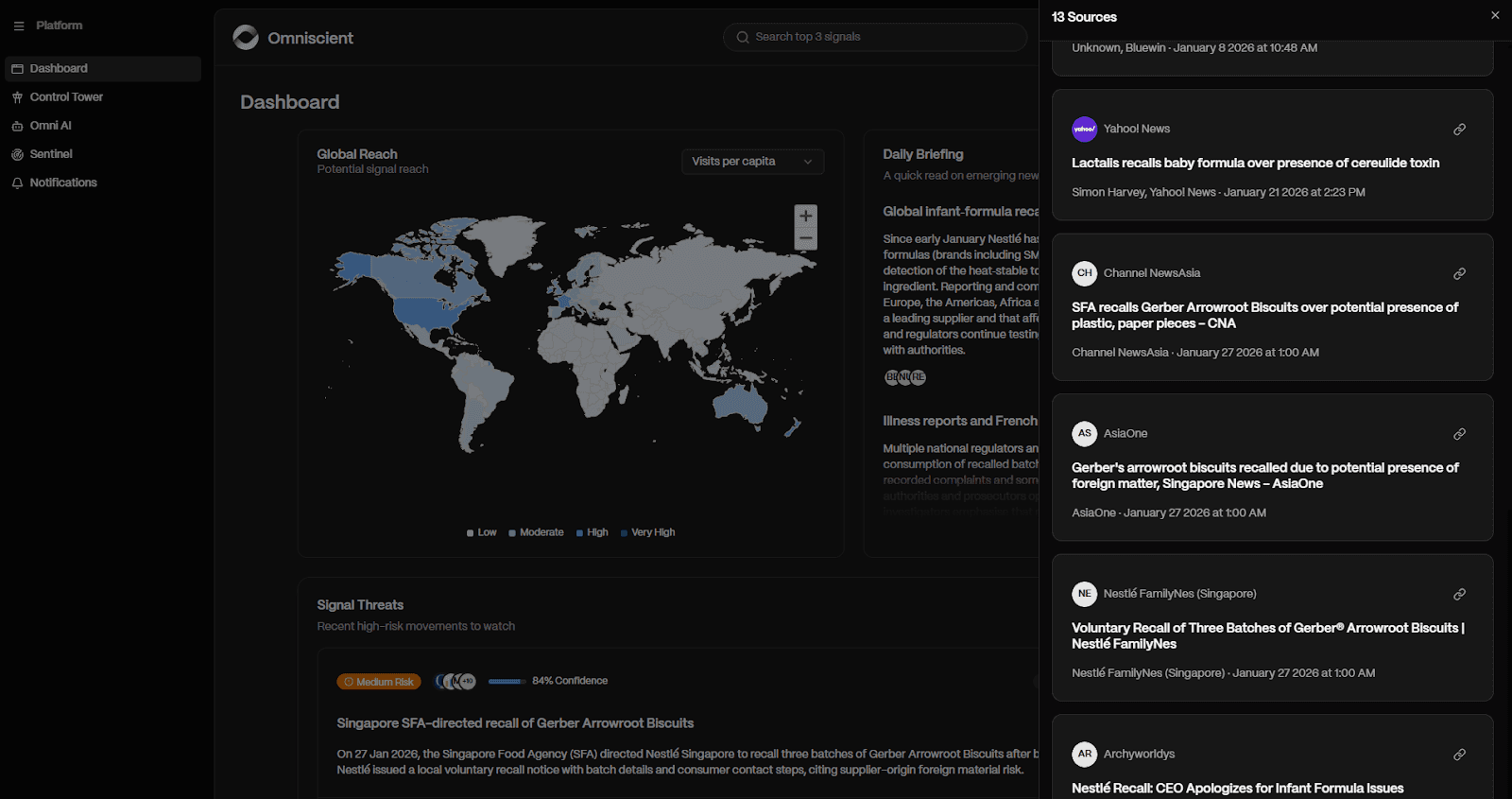
Authority Assessment: The agent queries Omnidex’s verified publisher index to identify relevant media outlets and collect authority metrics, including estimated daily visits and publisher credibility scores.
External Validation via Linkup Search: Using Linkup, the agent performs targeted web searches to determine whether the detected controversy is reported beyond Omniscient’s internal index, ensuring broader signal validation.
Content Retrieval with Linkup Fetch: If relevant sources fall outside the verified authority list, the agent invokes Linkup’s Fetch endpoint to retrieve clean, scraped versions of the source content for direct analysis.
By explicitly instructing agents to rely on Linkup for both discovery and content retrieval, Omniscient keeps verification fully embedded within the reasoning workflow. This approach ensures that all analyses are grounded in high-authority, verifiable sources – without requiring agents to leave the execution context or rely on brittle scraping logic
Impact: Reliable Signals and Trusted Citations
Switching to Linkup has allowed Omniscient to move from a "best guess" model to a "verified truth" model:
3x Fewer Hallucinations: By grounding agents in cited, high-quality data, the platform has seen a dramatic drop in fabricated signals.
50% Latency Reduction: Linkup provides data twice as fast as Omniscient’s previous internal scraping setup, enabling real-time crisis monitoring.
Verified Hypotheses: Agents can now autonomously call the Linkup toolchain to double-check claims, ensuring that the reputational alerts sent to clients are backed by trusted citations.
Streamlined Logic: The separation of information gathering (Linkup) and reputation analysis (Omniscient) allows the team to focus on their core product without worrying about the complexities of web crawling.
"The biggest win is a reliable, dependable way for our agents to answer ad hoc questions with trusted citations. The ready-to-consume answers mean we save tokens compared to processing all of the content ourselves." – The Omniscient Team
About Omniscient Omniscient, as part of their advanced decision making suite, provides state-of-the-art corporate reputation monitoring through autonomous agentic workflows. Their platform helps organizations to identify and manage market signals with institutional-grade precision. Learn more at omniscient-ai.io.